Status as of November 17, 2026: Allegheny County Article VI (last revised Oct. 20, 2026) and the City of Pittsburgh's 2021 International Property Maintenance Code (effective Dec. 18, 2024) are in effect. Pennsylvania's Carbon Monoxide Alarm Standards Act (Act 121 of 2013) is unchanged.
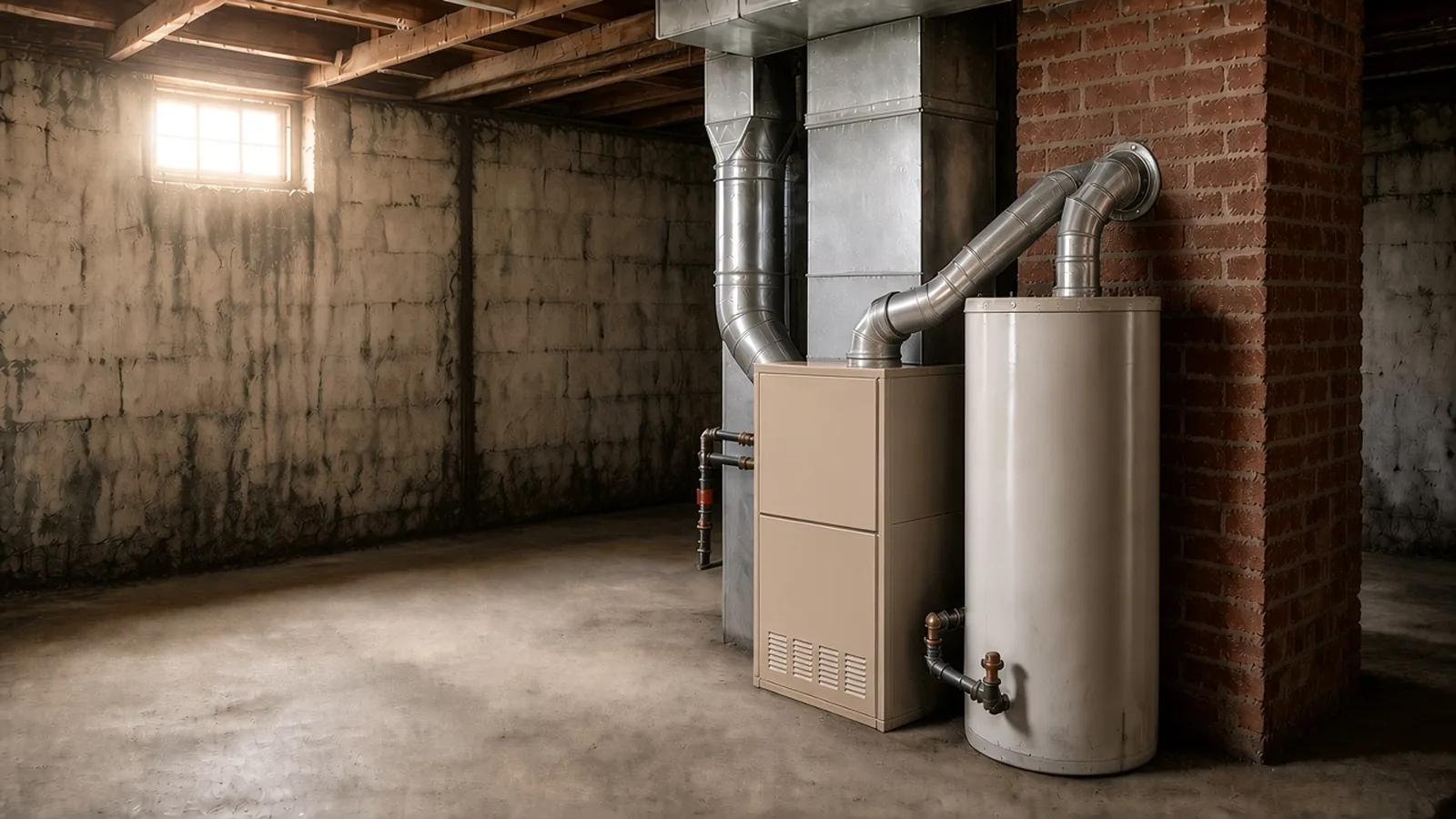
A lot of the houses I walk in Pittsburgh still heat with a gas furnace or boiler that vents through a masonry chimney, and many still have a naturally vented gas water heater sharing that same flue. When the chimney is clear and sized for the appliances on it, hot exhaust leaves the building. When it isn't, those gases, including carbon monoxide, can spill into the basement and move up through the house. Carbon monoxide is colorless and odorless. You will not smell it the way you might smell a gas leak.
This is one of the building-system issues we look at in our reviews. An obstructed or oversized chimney is easy to miss on a walk-through and expensive to ignore.
How backdrafting happens in older houses
Older gas furnaces and most conventional gas water heaters are naturally drafted. They pull combustion air from the room and rely on a hot flue or masonry chimney to carry exhaust outside. The U.S. Department of Energy's Building America program explains that these appliances can backdraft: combustion gases, including carbon monoxide, spill from the draft hood or combustion chamber into the room instead of leaving through the flue. A related failure is flame rollout, when negative pressure in the room pulls the burner flames out of position.
Pittsburgh's older masonry chimneys give this more chances to happen. Clay liners crack, shift, or collapse. Debris collects at offsets and cleanouts. Birds and animals nest at the top. Some flues were never lined. The Consumer Product Safety Commission tells owners to have the heating system professionally inspected and serviced every year, and says that inspection should include chimneys and flues for blockages, corrosion, disconnections, and loose connections.
A second, very common problem follows an efficiency upgrade. When a mid-efficiency furnace that shared the chimney is replaced with a high-efficiency condensing furnace that vents through PVC out a side wall, the gas water heater is often left alone on the old flue. DOE's furnace-replacement checklist calls this an orphaned water heater, and it tells the contractor to warn the owner that the existing chimney may no longer have adequate draft. DOE's combustion-safety guideline adds that relining may be required under the National Fuel Gas Code and the International Fuel Gas Code if the chimney is too large for the appliances still connected to it. An oversized flue lets the exhaust cool too quickly, which weakens draft and can send condensate into the liner. The usual fixes are a liner sized for the water heater alone, or replacing the water heater with a unit that vents on its own.
Allegheny County's carbon monoxide regulation (Article XII) also requires gas water heaters installed or used in the County, other than approved unvented heaters, to be connected to a proper, adequate, and safe chimney, flue, or vent, with adequate combustion air.
Signs of a problem, and how a technician checks
Do not try to repair a venting problem yourself. Building America says that if you see signs of backdrafting or flame rollout, contact an HVAC professional as soon as possible. If a carbon monoxide alarm is sounding, or anyone has symptoms, leave first.
Signs a technician, and an attentive owner, look for include soot or discoloration around the burners or at the draft hood (Building America); corrosion, gaps, missing sections, or disconnected vent pipe (DOE, CPSC); and liquid water in a vent connector, at a cleanout, or at the base of a liner, which points to condensation and the need for repairs (DOE).
A qualified technician can also run a spillage test at the draft hood. DOE's combustion-safety guideline, which follows National Fuel Gas Code practice, is to test at the draft-hood relief opening after five minutes of main-burner operation, using the flame of a match or candle or smoke. Spillage that continues after that five-minute mark is a failure. That is a professional test, not a substitute for leaving the building when an alarm sounds.
If you are buying, or you just replaced a furnace and left a water heater on the old chimney, ask for a proper chimney inspection, not just a look at the draft hood. The Chimney Safety Institute of America, describing NFPA 211, says a Level 2 inspection is used when conditions of use are changing, including adding an appliance or replacing one with a dissimilar appliance (different fuel, efficiency, or type). It is also used when a property is being sold, before lining or relining, or after a fire, storm, or operating malfunction that may have damaged the chimney. A Level 2 inspection includes the accessible attic, basement, crawl space, and roof, and CSIA says a video scan of the flue interior is required so the inspector can see liner cracks, unused openings, offsets, obstructions, and whether the flue is sized for the appliances that remain.
If a carbon monoxide alarm sounds
Treat it as an emergency. CPSC, the Allegheny County Health Department, and the local gas utilities agree on the first steps:
- Get everyone to fresh air immediately. Do not stay inside to look for the source.
- Call 911.
- Do not go back in until emergency responders say it is safe. CPSC warns that you could lose consciousness and die if you re-enter too soon.
- Then call your gas utility. Peoples treats carbon monoxide symptoms as a gas emergency and tells customers to leave the area and call 1-800-400-4271 (24/7) and 911. Columbia Gas of Pennsylvania tells customers to go outside, call 911, and then call 1-888-460-4332 (24/7).
- Do not operate a malfunctioning appliance again until a qualified technician has found the cause and repaired it.
Carbon monoxide poisoning can feel like the flu without a fever: headache, fatigue, nausea, dizziness, or shortness of breath, according to CPSC. People sometimes feel worse at home and better when they leave. Anyone with those symptoms should get to fresh air and call 911 even if no alarm has sounded. A working alarm is a last line of defense. It is not a substitute for a chimney and appliances that actually vent.
What the law requires for CO and smoke alarms
The rules are layered, and they are not identical. The County is stricter than the state on carbon monoxide locations. The City is stricter than the County on putting a smoke alarm inside each bedroom. Meet the strictest rule that applies to the property. A CO alarm in the basement and on every level, plus a smoke alarm in each bedroom and on every level, is also the arrangement I recommend even where a narrower legal minimum might exist.
Allegheny County (Article VI, Section 643) applies countywide, including the City. The Health Department enforces it, municipalities may enforce it too, and the more stringent of the County rule or a local code controls.
Carbon monoxide alarms are required in a dwelling that has a fuel-fired appliance or an operating fuel-burning fireplace, or an attached garage with an opening into the dwelling (and also when part of the dwelling is under renovation). When they are required, they must be installed in the immediate vicinity of each sleeping area and on every story, including a basement or cellar. That is the legal basis for a CO alarm in the basement and on every level in a typical gas-heated rental in this County. The County Health Department's own CO handout says installation on every floor, particularly near sleeping areas, "is REQUIRED in rental units according to Allegheny County regulations."
For smoke, ordinary one- and two-unit dwellings, and dwelling units of multiple dwellings, need a detector at or within 21 feet of the door of every sleeping room, measured along the path of travel, and on each story, including basements and cellars. The County expressly requires a detector inside every sleeping room in rooming houses, but not in those other dwelling-unit categories. The owner or operator must provide and maintain the required detectors. If they are battery operated, the occupant of a dwelling unit is responsible for batteries inside that unit; the owner remains responsible for batteries in rooming units, light housekeeping units, and common areas. Combination CO/smoke alarms are allowed if they are operational.
City of Pittsburgh. The City adopted the 2021 International Property Maintenance Code effective December 18, 2024 (Ordinance No. 34 of 2024), and Chapter 781 rental-permit inspections use the IPMC. A City-posted rental inspection checklist (labeled draft) tells inspectors to confirm that smoke alarms are at the required locations and functional under IPMC 704.6 and 704.7, and that carbon monoxide alarms are at the required locations and functional under IPMC 705. The owner or applicant has to provide a way for the inspector to test both. The same checklist also asks whether fuel-burning equipment has a chimney or vent to the exterior that is in good repair, without signs of decay or rust, and whether combustion air and safety controls are provided (IPMC 603).
For smoke, IPMC 704.6.1.2 requires alarms outside each separate sleeping area, in each room used for sleeping, and on each story of the dwelling unit, including basements (not crawl spaces or uninhabitable attics). The City's February 22, 2016 PLI bulletin, written under the prior code, used the same three locations. So in the City, a smoke alarm in each bedroom and on every level is the code minimum, not an extra precaution. IPMC 704.7 also says smoke alarms in one- and two-family dwellings must be replaced no more than 10 years from the date of manufacture, or if that date cannot be determined.
For carbon monoxide, IPMC 705.1 requires installation in accordance with International Fire Code Section 1103.9, except that dwellings covered by the International Residential Code follow IRC Section R315. The City's 2016 bulletin, which is older than the 2021 adoption, places CO alarms "centrally located outside of each separate sleeping area in the immediate vicinity of the bedrooms," and requires them in one- or two-family dwellings that are undergoing renovations and in apartments of multifamily buildings that have an attached garage or fuel-fired appliances. That sleeping-area location is narrower than the County's every-story rule. In the City, the County requirement still applies, and the stricter rule controls, so a typical gas-heated house should have CO alarms near the bedrooms and on every story, including the basement. The 2016 bulletin allows new alarms in existing dwellings to be battery operated and does not require them to be interconnected. Existing hard-wired, interconnected alarms are to be maintained as installed. Smoke alarms are to be listed to UL 217; CO alarms to UL 2034.
Pennsylvania Act 121 of 2013 is narrower than many owners assume. Its installation mandate applies to a multifamily dwelling, defined as a building intended for three or more households living in separate apartments and cooking on the premises, if the building has a fossil fuel-burning heater or appliance, a fireplace, or an attached garage. Each apartment must have an operational, approved, centrally located CO alarm in the vicinity of the bedrooms and the fossil fuel-burning heater or fireplace. The owner must install it, replace one that is missing or inoperable from a prior tenancy, and make sure the batteries work when a new occupant moves in. During occupancy, the occupant is responsible for testing, battery replacement, and upkeep, and must notify the owner in writing of deficiencies. Responsibility returns to the owner when the unit is vacant.
For a detached one- or two-family dwelling, the Act does not require the seller to install CO alarms. It requires the seller to disclose information about CO detectors on the property disclosure statement. Approved alarms include UL 2034 units and listed combination smoke/CO alarms that clearly differentiate the two signals. Willful failure to install or maintain a required alarm is a summary offense with a fine of up to $50. The Act allows municipalities to adopt equal or more stringent requirements, which Allegheny County and the City of Pittsburgh have done.
The practical result: a CO alarm in the basement and on every level is the County legal minimum for most rentals with a gas furnace, gas water heater, fireplace, or communicating attached garage, not just a preference. A smoke alarm in each bedroom and on every level is the City legal minimum. Outside the City, County code requires a smoke detector within 21 feet of each bedroom door and on every story; putting one in each bedroom still meets that rule and matches the City standard. Pennsylvania Act 121 does not, by itself, require CO alarms in a one- or two-family house, and it does not require a CO alarm on every level of a covered apartment unless that is where the bedrooms or the fuel-burning appliance are.
What I would do as an owner
- Confirm every unit has working CO alarms near sleeping areas and on every story, including the basement, listed to UL 2034
- Confirm smoke alarms in each bedroom, outside the sleeping area, and on every story, including the basement, listed to UL 217
- Test them, replace units at end of life (smoke alarms in one- and two-family dwellings no later than 10 years from the manufacture date under IPMC 704.7), and keep locations and dates in the unit file
- Put detector locations, testing, and "call 911, then the gas company, and tell the landlord" instructions in the lease packet and the move-in walk-through
- Have the furnace or boiler and the gas water heater professionally serviced, and the chimney inspected, before each heating season
- If a furnace was replaced with a high-efficiency, PVC-vented unit and a naturally vented water heater is still on the old chimney, have a Level 2 chimney inspection and, if needed, a correctly sized liner or a new water heater
- Keep Peoples (1-800-400-4271) or Columbia Gas of Pennsylvania (1-888-460-4332), and your HVAC contractor, with your after-hours numbers
- If a CO alarm sounds or someone feels ill: out of the building, 911, then the utility. Do not send a tenant back in to "check the furnace"
Winter already puts more stress on these systems. We covered freeze prep, including the main water shutoff, in Before the Deep Freeze: A Pittsburgh Landlord's Guide to Hose Bibs, Exposed Pipes and the Main Water Shutoff. If a heating appliance is unsafe and the unit loses heat, Allegheny County can treat that as an emergency and, under the new relocation rule, bill the owner for hotel stays when negligence makes the unit uninhabitable. See No Heat, Hotel Bill: What Allegheny County's New Relocation Rule Means for Landlords.
How PRC helps
Venting and detection are part of the building-system review we do for clients. A Desktop Deal Screen flags age, fuel type, and construction issues that often go with old chimneys and naturally vented appliances, before you make an offer. An Acquisition Review goes on site and sets out what to have your inspector, HVAC technician, and chimney professional check, including whether a water heater was orphaned on the flue, whether the chimney needs a Level 2 inspection or a liner, and whether CO and smoke alarms already meet the County and City rules, so those costs are in your numbers before closing. For buildings you already own, Stabilization & Turnaround Advisory can build the annual service, chimney, detector, and tenant-notice routine into the operating plan.
Want a second set of eyes on a property's mechanicals and safety equipment? Book a free 20-minute discovery call.
Sources
- Pennsylvania General Assembly: Carbon Monoxide Alarm Standards Act, Act of Dec. 18, 2013, P.L. 1229, No. 121 (also posted on PALegis)
- Allegheny County Health Department: Article VI, Houses and Community Environment (PDF), Section 643 and Section 605. Last revised Oct. 20, 2026
- Allegheny County Health Department: Article XII, Carbon Monoxide Hazards (PDF), Section 1205
- Allegheny County Health Department, Housing and Community Environment: What to know to protect yourself from carbon monoxide (PDF)
- City of Pittsburgh: Ordinance No. 34 of 2024 (File 2024-1273), adopting the 2021 IPMC, effective Dec. 18, 2024
- City of Pittsburgh PLI: Smoke Alarm and Carbon Monoxide Alarm Requirements in Existing Dwellings (Bulletin, Feb. 22, 2016) (PDF)
- City of Pittsburgh PLI: Residential Housing Rental Permit Program Draft Inspection Checklist (PDF), citing IPMC 603, 704.6, 704.7, and 705
- International Code Council, 2021 International Property Maintenance Code, Sections 704.6, 704.7, and 705
- U.S. Consumer Product Safety Commission: Carbon Monoxide Questions and Answers
- U.S. Department of Energy, Building America Solution Center: Look for Signs of a Gas Furnace Backdrafting and Gas Furnace Replacement checklist
- L. Brand, Gas Technology Institute, for DOE Building America: Measure Guideline: Combustion Safety for Natural Draft Appliances Using Indoor Air (PDF) (April 2014)
- Chimney Safety Institute of America: Level 2 Inspection of a Masonry Chimney (PDF), describing NFPA 211 Level 2 inspections
- NFPA 211, Standard for Chimneys, Fireplaces, Vents, and Solid Fuel-Burning Appliances
- Peoples: Emergency and Contact (1-800-400-4271)
- Columbia Gas of Pennsylvania: Carbon Monoxide and Contact Us (1-888-460-4332)
This article is general information for property owners, not legal, mechanical, or medical advice. Detector and venting rules can differ by municipality and by the work being done, and they can change. Confirm requirements with the Allegheny County Health Department, the City of Pittsburgh Department of Permits, Licenses, and Inspections or your local code official, and a licensed HVAC or chimney professional. If a carbon monoxide alarm sounds or someone feels ill, get to fresh air and call 911.
Want a second set of eyes on your rental?
Talk with Eddie about your property, your concerns, and the right next step.
Book a free 20-minute discovery call